.png)

CNC Machines
Elevate your manufacturing with our range of top CNC machines, perfect for beginners cutting simple materials, advanced users seeking enhanced features, and businesses running parts 24/7. Whether you need a wood CNC machine for precision woodworking or a hobby CNC machine for smaller projects, we have the ideal solution to meet your needs.

Emergency Stop Switch
See details
$24.50
$24.50
What's the difference between the Gen 2 Elite Series and Gen 1 Elite Series?
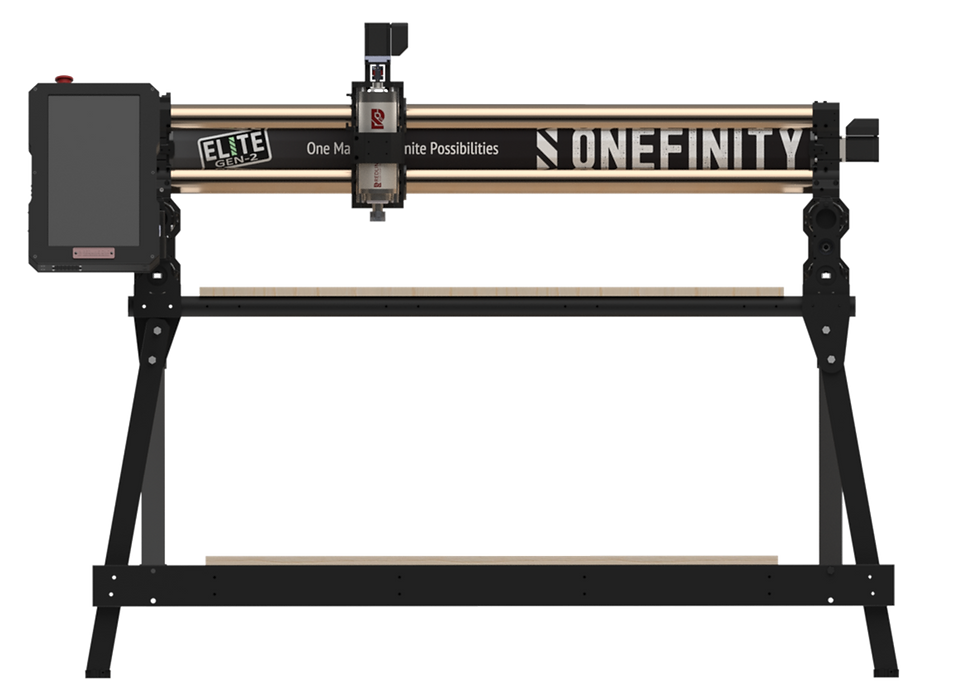
The Gen 2 Elite Series, introduced in November 2025, represents the most advanced, rigid, and capable CNC machines Onefinity has ever produced. The Gen 1 Elite Series, introduced in 2023, was the previous generation and laid the foundation for what would become the Gen 2 platform.
Built from the ground up for maximum stiffness and performance, the Gen 2 Elite features 60 mm X-axis tubes and 50 mm Y-axis tubes, making it 100% more rigid than a comparable Gen 1 Elite and 50% more rigid than a Gen 1 Elite equipped with the optional third “stiffy” rail. Because of this increased rigidity, no additional third rail is required on Gen 2 machines.
Power has also been significantly upgraded. Gen 2 Elite machines use 2 Nm motors on the X and Y axes, compared to 1.2 Nm motors on Gen 1, delivering more torque, higher cutting power, and improved performance at speed. A larger power supply further supports these upgrades, ensuring consistent power delivery under demanding workloads.
To improve reliability and longevity, the Gen 2 Elite includes integrated ball screw covers, protecting the ball screws and ball nuts directly at the source. Gen 1 Elite machines leave these components exposed, making them more susceptible to dust and debris.
The Z-axis has also been strengthened. Gen 2 Elite machines feature a beefier Z-20 slider with a thicker, more robust spindle mount, reducing deflection and improving rigidity during Z-axis cutting operations. Both Gen 1 and Gen 2 Elite machines use the same 1.2 Nm braking motor on the Z-axis, ensuring secure vertical positioning.
The electronics platform is also significantly different between the Gen 1 and Gen 2 Elite machines. Gen 1 Elite machines use the Masso G3 touch controller, a proven industrial controller that was introduced in 2020. While reliable, it reflects an earlier generation of CNC control technology.
The Gen 2 Elite Series uses the Redline HMI paired with the RealTime Motion Controller, an advanced, modern control system introduced in 2025. This system was designed specifically around the Onefinity ecosystem, offering a more user-friendly interface, faster real-time motion control, smoother operation, and deeper integration with Onefinity hardware and accessories.
This electronics upgrade, combined with the mechanical improvements, makes the Gen 2 Elite not just a stronger machine—but a more refined and future-ready CNC platform overall.
While the Gen 1 Elite (2023) remains a capable machine, the Gen 2 Elite Series (2025) delivers more rigidity, more power, better protection, and higher overall performance—making it the top-of-the-line CNC solution in the Onefinity lineup.
What’s the difference between the Gen 2 Elite Series and the Apprentice?
What’s the difference between the Elite Series 2 and the Apprentice?
The difference comes down to capacity, power, and who the machine is built for. The Apprentice is designed as a compact, affordable entry into CNC, while the Elite Series 2 is built for users who need larger cutting areas, higher performance, and long-term expandability.
Is the Apprentice a beginner machine?
The Apprentice is designed to be approachable and cost-effective, but it’s still a very capable CNC. Its smaller cutting area makes it ideal for signs, small parts, fixtures, and classroom or hobby use. The simplified hardware keeps setup and operation straightforward, which helps new users get cutting quickly without unnecessary complexity.
What advantages does the Elite Series 2 offer?
The Elite Series 2 offers significantly more cutting area, stronger motion components, and higher overall performance. It uses heavier rails, ball screws with covers, increased Z travel, and closed-loop motors for more torque and confidence when cutting harder materials or running faster feeds. It’s designed for larger projects, production work, and users who don’t want to outgrow their machine.
Do both machines use the same controller?
Yes. Both machines use the Redline CNC controller, so the interface and workflow are consistent across the lineup. The difference is in the hardware the controller drives. The Elite Series 2 pairs the controller with higher-performance motors and features like optical homing, while the Apprentice uses simpler components to keep cost and complexity down.
How do they compare in everyday use?
The Apprentice is compact, efficient, and easy to fit into smaller workspaces. It’s ideal for learning CNC or focusing on smaller projects.
The Elite Series 2 feels more like a production-ready machine, offering higher speeds, greater rigidity, and the ability to handle larger materials and more demanding workloads.
Which machine should I choose?
Choose the Apprentice if you’re new to CNC, working in a limited space, or focused on smaller projects and affordability.
Choose the Elite Series 2 if you need larger cutting capacity, higher performance, or a machine designed for long-term growth, production use, and expansion.
Both machines deliver the accuracy and rigidity Onefinity is known for — they’re simply built for different stages of your CNC journey.
How much does a CNC machine cost?
The cost of a CNC machine varies widely based on its size, capabilities, and features. Prices can range from a few hundred dollars for a 'throw away' machine, a few thousand dollars for entry-level machines to several hundred thousand dollars for high-end industrial models.
How to program a CNC machine?
Programming a CNC machine involves writing or generating G-code, which is the language that CNC machines understand. This code can be written manually or created using CAM (Computer-Aided Manufacturing) software, which translates CAD designs into machine instructions.
How to operate a CNC machine?
Operating a CNC machine requires loading the CAD design, setting up the machine with the correct tools and materials, calibrating the machine, and running the CNC program. It is important to monitor the process and make adjustments as needed for optimal results.
How does a CNC machine work?
A CNC machine works by following programmed instructions to move cutting tools or other machinery parts precisely. It translates digital designs into physical products through a series of controlled movements, guided by software and precise motors.
How to use a CNC machine?
Using a CNC machine involves several steps: designing a CAD model, converting the design to a CNC program (G-code), setting up the machine with the appropriate tools, and running the program to manufacture the part. Proper training and safety precautions are essential.
What does a CNC machine do?
A CNC (Computer Numerical Control) machine is a manufacturing tool used to control machinery with computer programming inputs. It automates precise cutting, drilling, milling, and other manufacturing processes, enhancing productivity and accuracy.
Frequently asked questions